Showing posts with label fire. Show all posts

Friday, September 29, 2023

Nomads, days 27 and 28 (9/29/3023)

We are getting closer to home, although on the spur of the moment we decided to extend our trip by cone more day. However, that is not the subject of the day; you will have to wait for the next post for that update. In this report, we are now about to turn east and head for home.

Day 27: Alamosa (CO) – Walsenburg – La Junta (CO) – Dodge City (KS)

Day 28: Dodge City – Spearville – Newton – Kansas City – Lee’s Summit (MO)

Now I am wondering myself, why mention these towns or cities in between? The reason for one is, so you the reader can follow the route on a map or some mapping program. Secondly, the locations mentioned here are somewhat significant on our travels. La Junta and Newton were lunch spots. In La Junta we had our first Sonic on our trip (actually in our life), but since we are traveling with dogs, lunch is in the van with the AC on. Moreover, at Sonic you can park under a canopy, somewhat in the shade. Sonis was not what you call fine dining; but it was ok. In Newton we stopped at a BBQ chain. That one was OK and we were somewhat enchanted by that small town.

We got gas in Walsenburg. One of the (not so) secret goals of our trip is to find yarn stores and boy, it looks like there was one right across the gas station. To our mutual disappointment, Edla’s had shut down. From the looks of it, the shop might have been closed for the past 40 or so years.

Other reportables include the huge windmill array in Spearville, and on day 27 the wonderful descent from 7500 feet in Alamosa to the shortgrass prairie in eastern Colorado. We drove along the Santa Fe trail (another thing to follow one of these days, or maybe the Oregon trail, or even the Mormon trail).

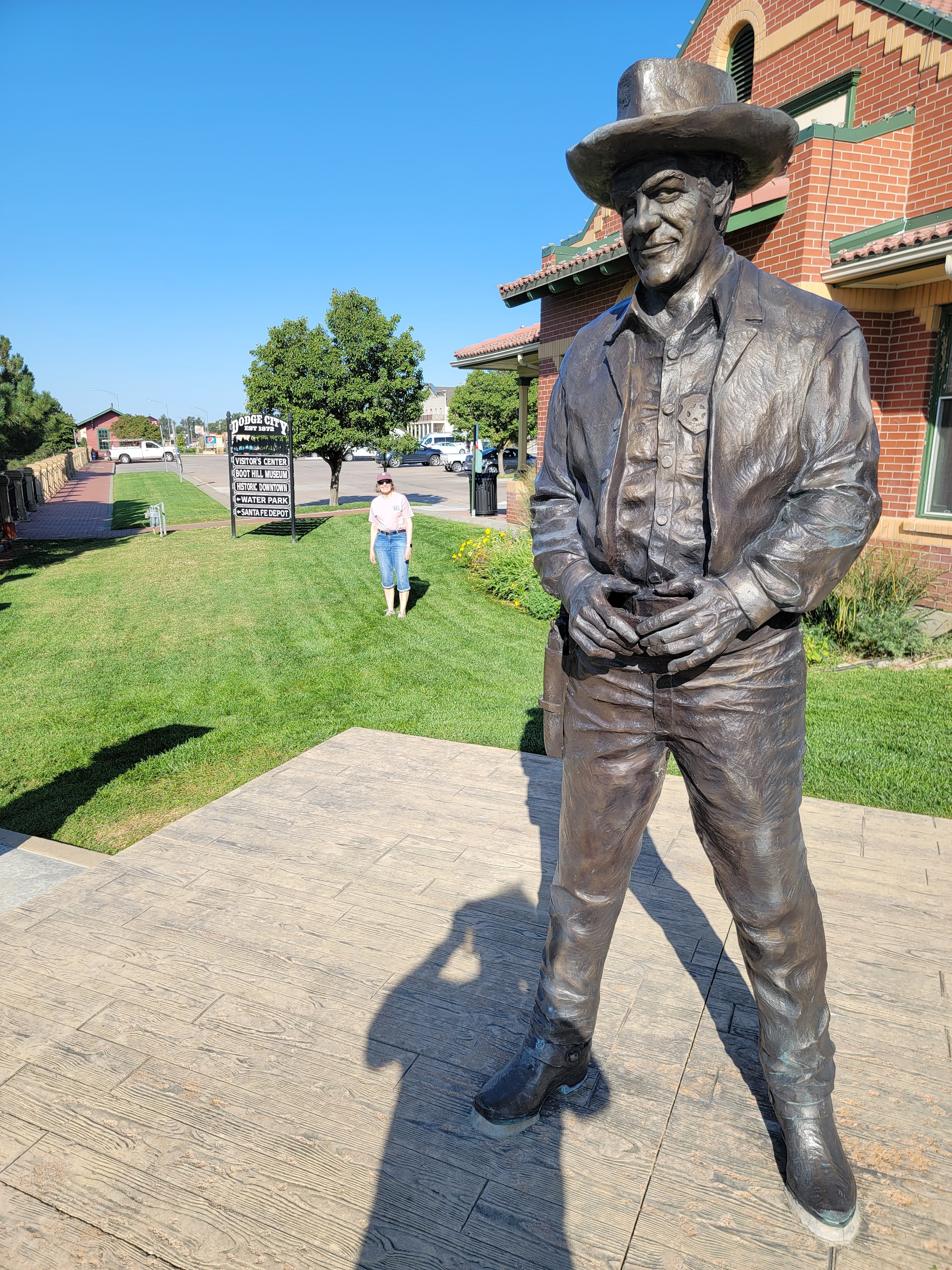
Finally Dodge City! Folks who know me know that during my lunch hour I used to go for a walk whenever I was working at the office in Richmond. My excuse was always that I needed to “get the hell out of Dodge.” In other words, it was time for me to put action to my words and get the hell out of Dodge. However, to leave you first have to enter and I needed to visit the famous western town Dodge City. Naturally, we needed to stay at the Gunsmoke TV park and visit Boot Hill. The camping was overrun by flies, and fair. Truthfully, we had our share of flies during our trip, but being in feedlot country really contributed to the number of flies that pestered us (and Radar). Dodge City, been there bought the t-shirt (literally).

We fell in love with the camping location in Lee’s Summit. This was at a county park and simply delightful. It was clean, well maintained and cheap ($20 per night). County parks have not disappointed us, to date. On the way over, we hit another wool store that was closed.

The last item in today’s report was the weather. For a weather channel junkie, somewhat science guy, and a meteorologist as wife, it was fascinating to watch the “dry” line set up. This is an imaginary line in the sky where thunderstorms develop and move east. It is a line between the dry desert air and moist air coming from the Gulf of Mexico. It was beautiful and from just west of La Junta to Dodge City we watched them develop. Based on the radar on our phone, one particularly large one seems to develop near Tucumcari, NM. It was beautiful to watch it grow to an amazing huge storm of an hour or so. In Garden City, just before Dodge City there were another few that were developing. Unlike what we have in Virginia, where thanks to the trees, we were treated to a visual spectacle watching storms develop. It was so nice to see the horizon.
The descent from Alamosa showed scares from a burn that must have occurred a year or so ago.  Root sprouters like aspen seemed to have survived the fire 

Developing thunderstorms on the "dry line"

Garden City thunderstorm

I shot the sheriff

Tuesday, June 13, 2023

Welcome to Mars (6/13/2023)

Welcome to Mars, at least that is what photographs from New York City look like. Here in coastal Virginia, I am not so sure what the sky equates to. A combination or hybrid between Mars and the old Los Angeles? These is just a grey haze outside, like it is supposed to be very humid. However, it is slightly orangey or pinkish. Moreover, it is not warm, as in warm and humid. On top of that, the air smells.

You must be living under a rock if you do not know what this is all about, the Canadian wildfires. Although, on our neighborhood’s Facebook page, one lady actually asked the question what was wrong with our air. The other day we received the wrong newspaper and the Wall Street Journal, which we normally don’t read, had an editorial in which they blamed poor forest management for the fires. It is like a country that has 40% of its landmass covered by forest and has roughly 38 million people can manage all those forests. Moreover, all those forests are usually covered by snow for a couple of months a year and therefore inaccessible. The truth is that there is a heat dome parked over Canada, this early in the year. Couple a very (record) warm May with an extensive (record) drought and you create a tinder box. Nothing or very little to do with poor forest management. But it is easy for the right wing to blame everything on poor forest(environmental) management and absolutely ignore any sign of climate change or global warming. Moreover, they are convinced it is cyclical.

Heat and drought in Canada? How come? Well, I have written a lot about climate change, and guess what? VoilĂ , more evidence. With climate change or global warming, it seems that the northern latitudes warm up faster than us in the lower ones. This is the phenomenon we are experiencing. Hopefully this past week’s experience will wake up a few, although it seems we have a lot of political distractions lately.

I downloaded this photograph from MSN news who got it from Reuters News..  If this is copyrighted, I am sure they will let me know.  However, to me this shows me and the world what it was like in New York City this past week as a result of the Canadian wildfires.  It also shows you why I titled my post "Welcome to Mars."


Tuesday, October 8, 2019

Remember nature? (10/8/2019)

The pre-Socratic Greek philosopher Heraclitus is believed to have said “It is not possible to step twice into the same river.” The reason being that even seconds later conditions in that river have changed. Different water molecules would be running by and touching your legs, aquatic organisms have moved and even particles of sand and sediment have been washed away, down stream. You yourself have aged and you are not the same as a split second ago. This may be scary when you think about it, but on the other hand it could also be comforting.

I was thinking about this when I finally dared to venture out into the woods behind our home again. The night-time temperatures finally dropped below 60° F (15.5° C), which means the chiggers go into hibernation and it gets less uncomfortable to venture into the woods. 

The woods have definitely changed over the past half year. For one when we last walked outback (as we call it) is was very wet and we had to dodge puddles. However, we have been in a drought, lately. I do not think it has rained for at least a month and instead of coloring, the leaves are shriveling. I am just hoping we don’t get a forest fire back there. While it would be good to have a good ground fire in the woods behind our home as I discuss in some of my posts, it is so dry that I fear for a crown fire and our homes.  It has really become a climate of extremes.

It has been so dry that the ponds have dried up, and even the puddles in the road which usually stay wet throughout the year are dried up. The largest pond behind our home has just a little pool left in the middle.  I am not sure if it has fish in it, but it usually has a healthy turtle population and I wonder how they are faring.  All ponds behind our home are ephemeral (with the possible exception of the large one) and they are fed or reflection of the groundwater levels.  This means that the levels usually fluctuate 5 to 6 feet every year; however, this year they seem to have dropped more than that.  Surprisingly, some of the grass along the trail was still green, while the grasses in the lawns in the yards of our subdivision are browning up. The entire south-eastern U.S. appears to be drought stricken this year, and the temperatures are way above average for the year. 

This is a picture that I took two weeks ago of the large pond and the water has dropped even more.
During our car ride back from our Century bike ride on the Eastern Shore of Maryland (which was fun, by the way), we were listening to NPR’s Weekend Morning Edition Sunday. They interviewed Larch Hanson, a seaweed harvester in Maine. Larch quoted Wendell Berry from one of his essays in “What are People for?” Berry wrote: “People are for preserving memory of place!” I guess that is what I have been doing with my blog posts over the years; trying to document the subtle changes in the woods behind my home. However, at times, while blogging, I can’t help myself and I also try to document the changes in my thinking and the society and of course in the politics around me.


A photo of my wife and I taken by fellow cyclists during the century ride this past weekend on the eastern shore of Maryland.  We had a lot of fun.  It was cold and very windy (first cold day, hence the packed in look).
Hanson said in his interview: “The water remembers us!” I would like to make an argument that nature remembers us, as well. Whatever we do to her will come back to haunt us, as we are currently experiencing with global warming. Yes, what we are seeing will likely accelerate, and Heraclitus’ philosophical outlook on life will become more and more apparent. Nature around us will start changing faster and faster and not for the better, and soon we can talk about the good old days. This is why, as Wendell Berry mentioned, we better preserve the memories of how nice it was back then (read now) by documenting it in our writing and photography while there is still time.  This is what I try to do in my writing and I hope you do that too in your form of communication with your friends and loved ones.

Wednesday, November 21, 2018

Come on baby, light my fire (11/21/2018)

On January 8, 2015 Donald Trump, the man soon to be our president tweeted the following:

“Who is paying for that tedious Smokey Bear commercial that is on all the time - enough already!”

The latest count (Sunday, November 18) of the ”Camp fire” is 77 people dead and 993 missing. During a visit, the president seemed to have claimed that more raking would have helped, because that is what they do in a forest rich Finland. Moreover, the president did mention that he did not think it was climate change that caused it, but that he wanted great climate, which left many who attended the meeting baffled at what he meant. I wonder if he got a whiff of some nearby pot plantations going up in smoke.

Well, as we all can imagine, the internet has been having fun with all this, but on a serious side, this is a terrible situation. I am not writing this blog post to complain about or have fun with our president; well I admit, maybe a little.

Forest fires are a serious business; as we can see they can cause the loss of life and extensive property damage. I am in no way trying to downplay the severity of what happened with the title of my blog.  The pictures and the videos on YouTube are horrific.  The problem is that wildfire is a natural element of nature and actually a vital part of nature in many cases, depending of course on the ecosystem. Forest fires are needed to open up the system, the decrease the litter or dead materials that have accumulated on the soil surface.  Our problem is that fire suppression has caused the accumulation of too much fuel which results in these destructive fires.


The accumulating material also causes other problems.  It chokes out the seedlings and small plants trying to germinate, and areas that are burned show a tremendous greening up after a fire.  In addition, fire kills some of the smaller weedy species, sick and damaged trees; it opens up the canopy, allowing the sunlight to reach the floor of the forest giving the herbaceous plants an additional  chance to proliferate.

Some forest dwelling species are actually dependent on forest fires. My favorite example is the red cockaded woodpecker in the southeastern part of the U.S. This bird needs to nest in big old pine trees in a forest. However, these forest need to be open with often a grassy understory and no small trees. The way to maintain this was through fires. In the old days, this was not a problem, but with increased habitation, folks started controlling forest fires and oaks to the detriment of the woodpecker invaded the woods. Wildfires killed the oaks seedlings and the control of fire have a region-wide negative impact on the woodpecker population.

The woodpeckers were able to thrive in one particular area. That was on the life-firing ranges of military bases in the southeast. The life artillery often would set these areas ablaze with wildfires and this was just what the birds needed. While they were not bothered a lot by the artillery (except by a direct or a nearby hit), the resulting fires would keep the ecosystem open. Nowadays, managers use fire or control burns to manage remaining habitat of or restore habitat for the red cockaded woodpecker.

When we moved into our home some 18 years ago and walked in the woods behind our home, we noticed that the area had recently burned. There were black burn marks on the bases of the trees and actually, there were two areas that it obviously was replanted in the past 5 to 10 years, which I always assumed was the result of some kind of disturbance, which could have been a very intense crown fire.

Walking through the area with the burn marks now, I cannot find them anymore. The trees have grown and new bark has covered all the burn scars. It reminds me of some of the dendrochronology (tree aging) work I did in New Mexico in the late 1980. There, on 150 year-old or even older trees we could still see exactly what year there was a fire in these woods. In addition, we could see what direction the fire came from that year. It is pretty darn cool to be able to see that, but I digress. What it shows was that even in New Mexico where it is dry, the high elevation forests (at 7 to 9000 feet or so) did have a regular fire regime, as do most ecosystems in the U.S. Albeit, the fire frequency there was much longer.

Behind my home, like most in most of the ecosystems, fire suppression reigns supreme. What is happening is that there is a tremendous amount fuel building up in these areas. This include years of leaf litter, fallen branches, twigs and whole trees that were brought down by storms. The result is that herbs have a difficult time growing, seeds cannot germinate, and if a fire happens to get started, it may get so hot and high that it could get all the way into the canopy of the trees instead of being just a ground fire. Once it hits the tree canopy, the fire can spread fast and easily. It then can jump to roofs of homes and even create its own weather. Now it is difficult to contain. This is what we are seeing in California. 


This picture shows an area with some old fallen trees.  While a fire may burn some of this, these trees will most likely not create much of an issue during a wildfire.  They are wet and rotting.  They are likely to smolder; moreover, they are important habitat for the salamanders and other creatures living in the woods behind our home.
This area on the other hand has a lot of wood laying over each other like "pick up sticks."  This is already set up as a nice camp fire.  If we ever get a wildfire through here, I am afraid it is off to the races.  You can see the homes in the background.
 Sections of the woods behind our home have a huge accumulation of debris. We have had a number of hurricanes that threw trees, folks from our neighborhood have used it as dump for their yard waste, and we have had more than 25 years of accumulation of litter. I am not sure, but I estimate that the fire frequency of our woods is somewhere between 10 and 20 years, if not more frequent. Yes, our woods are very wet, so a fire would be spotty and a burn would look like the spots on a Dalmatian, or better the areas not burned would look like the black spots on a Dalmatian. However, that is ok, it contributes to the diversity of the woods behind our home. 

One thing is for sure, we need to stop being afraid of fire, because if we do, fuel will build up and we might end up with a catastrophic fire instead. While smoky is correct, control burns are good, and forest management is important. While control burns may not have prevented the “Camp fire”, together with well-funded forest management it might have been less severe and less catastrophic. The same could be the case behind our home. The woods are divided in two sections, and the part managed by Newport News is better managed and in better shape than the part managed by the National Park Service, which is underfunded. They simply do not have enough money to do forest management. 


People on Twitter were having fun with this picture after the president's visit to the disaster area in California over the weekend.  It is what has happened and what we are also seen in our National Park; a severe lack of funding.
Therefore, my call to action is to:
  1. Insist on fully funding forest and wildland management, whether that is by way of the Forest Service, the BLM, the National Park Service, or even your local state or county land/park management agency, and
  2. Make fire (read: control burns) your friend!

Saturday, November 14, 2015

Yorktown (11/11/2015)

The leaves are falling!

The leaf of a sassafras tree/shrub; one of my favorite species.  I just love the trident shaped leaves and while I do not like the taste of root beer, I love the smell of the crushed leaves which smell like root beer.  Old folklore tells me that in the south people would crush the roots and make tea from the roots claiming that the tea would make them better able to deal with the heat and the humidity of the summers.

Fall is definitively here.  It always seems to hit hard in November (see my post from around this time last year).  It is around Thanksgiving that I rake, blow or mulch for the last time.  The roads in our neighborhood are beginning to be lined with clear bags with leaves that are going to be carted off to the county's composting facilities (I hope), and maybe next spring these same people will bring some of the leaves back in a different form to fertilize and mulch their yard; although I would not bet on it.

Many of these people mine their yards for nutrients.  In one of the classes that I teach I surprise my student with the little factoid that fall leaves contain a lot of phosphorus and by us carting leaves of to the dump or to the composting facility we are really mining phosphorus and depleting our soil.  This forces us to go buy fertilizer at our landscaping stores and put artificial fertilizer on our lawns and gardens which we basically cart off again next fall.  The fertilizer companies  (and the garden stores) love us, don't they?

Our neighborhood has them all, there is this one guy, I swear, he gets the blower out when he sees one leaf on his lawn or driveway (he's obviously OCD).  My wife and I call him "Jack the Blower".  He has the leaf blower going for at least two hours every Friday, Saturday and Sunday (we are not home the other days so we don't know if he blows those days as well); one wonders what else he does in life, or if he has a life.  I feel sorry for his neighbors; who have told me that they actually caught him blowing leaves into their yard.  When we lived in Cincinnati 20 years ago, we knew an equally OCD guy (an ex FBI agent) and when we walked by his property we made sure to bring a leaf and  place one leaf on his lawn, just to tease him.  Boy, we were mean in our younger years.

But leaves are important, as I mentioned, they recycle nutrients and organic matter, but they also are the home to a lot of insects and other critters.  It is a lot of fun to see towhees and brown thrashers going after bugs in the leaves in my yard.  They do it just like chickens scratching away in the leaves, throwing them all over.


I took this photo a couple of days ago behind our home and titled it: "Fall massacre in full swing

But there is more, all the mushrooms that are out there are fed by the decaying leaves and rotting plant materials, salamanders lizards, frogs and a lot of other critters need them.  The fallen leaves serve as natural litter that keep  the weeds from growing; although, in some cases to much litter may be a bad thing as I complained about in an earlier post.  There is too much litter in the woods behind our home, which in my eyes has suppressed the native weeds and forbs.  The only way to remedy that would be with a controlled burn and good luck in getting that approved.

But again, it is important to mulch the leaves back into the lawn and back into the flower beds.  The organic matter, nutrients, weed control, and habitat for our wildlife provided by those leaves is so valuable!

Monday, April 13, 2015

Wakefield (4/11/2015)

Spent a wonderful time Saturday running around in Surry, Sussex and Southampton Counties.  This is a more rural/agricultural area of the coastal plains of Virginia.  Our road trip started with a ferry ride across the James River from Jamestown to Scotland.  We first visited Chippokes State Park.  They were holding a fiber festival and were sheering sheep and alpacas and selling wool and its paraphernalia and peanuts.  This was my first visit to Chippokes; I think I've always considered it less attractive and less charismatic, since it is so close to home, in an area that I know well, ecologically, environmentally and from being on the water so much.  But I was proven wrong; in our minds, while we were driving through the place, we were already renting a cabin for a weekend sometime this fall.  The fiber festival was small and intimate.

This visit was followed by lunch at the Virginia Diner.  The diner is a great place the have some interesting Virginia style food, and our current all time favorite: Peanut pie!  It seems that Guy Fieri from Food Channel's Diners Drive-Ins and Dives visited the diner for the first season of the show.  The Virginia Diner also sells lots of peanuts and it is a great meeting place.  That brings you to the economy of the area.  Driving around, you see agriculture and forestry; that's basically it.  Agriculture includes a lot of peanuts and pork, although I understand peanuts are somewhat on their way out and being replaced by cotton, corn and soybeans.

After lunch we visited a natural area that is managed in a different way than many of the woods here in Virginia.  The photograph below shows you what I mean:


Very rarely do you see a savanna type forest as you see in this photograph.  This type of forest (vegetation) is somewhat more prevalent further south, but even there it is on it's way out.  This vegetation is a typical example of a stand that is frequently burned.  Yes you can see some of the scarring on the trees, but pines can and will survive it, at least when the fire does not get too hot.  All the needles on the ground will burn up, giving grasses a better chance to get established.  Moreover, most of the broad-leaf species do not like fire and they are suppressed.  The photo below somehow show this as well.  The area to the left appeared to have been burned last year while the area on the right-hand side of the trail was burned a few years earlier.  You can see to invasion of the broad-leaf species such as oaks and gums.


As regular readers know, I am such a proponent of maintaining the natural balance in the woods.  I have lamented about the lack of predators in the woods (just look for the labels for "deer", "natural balance", or even "wolves", to read some of my postings on that subject).  The lack of fire in these forest ecosystems is another one of those things that is sorely missing in our area and in many areas.  Yes, fire consumes a lot of biomass in a forest (or at least it looks like that); it kills a lot of the hardwoods; it produces a lot of smoke; and it might threaten human life and property (as we see in some of the California fires), but the complete fire control allowed for the development of forests that the first colonizers would not recognize.  Driving back through Isle of Wight County after a day in these woods we were astonished that you could hardly look more than 10 feet into the woods and everything was blocked by crappy plants that live in the edge of wood lots.  A walk though the woods behind our home was an eye opener after a day like Saturday.  There in so much dead biomass built up in those woods from fallen trees, which in addition, to all the leaves and needles have made these woods a complete fire trap.  On top of that, these woods without fire are not very diverse.  The layer of leaves are basically prevents the seeds from germinating and this really impoverishes the forests.  Naturally those damn deer don't help.  An additional positive impact of fire is that it may keep some of the non-native plants that are trying to invade our woods under control.

It is amazing what the reintroduction of fire did to the area.  Our guide told us that he has never seen a fox in the area, while at the same time we stopped to admire some rare birds and carnivorous (flesh eating) plants.  In all, this again shows the result of humans modifying the environment we live in.  Whether it is killing wolves or suppressing wild fires, the environment changes as a result of these modifications, often with unintended and unanticipated results, all the while doing it thinking we are doing it for the benefit of humanity.  It was an exhilarating day and we learned a lot.


Monday, February 10, 2014

Yorktown Battlefield (2/7/2014)

This is what is called a “widow maker”, or one of those trees you do not want to cut down. This photo was taken in the Yorktown Battlefield National Historic Park.  Interestingly I am here near the border of the National Park and Newport News Park.  On the Newport News side trees like this are cleaned up, in the national park only the trails are kept open, but parts of the woods look like pick-up-sticks.  I don’t mind that at all, since it is more a natural appearance and provides a lot of habitat from birds and critters.  It may even provide some protection for plants from the ferocious deer we have in our area.  These deer will eat anything they can find and there is very little regeneration (except for plants they do not like) and very little herbaceous understory.  I kind of wish there was a way to cull the deer so close to the neighborhood.  On the other hand all these fallen trees make for an immense fuel load, and if we get a fire this will be the crown fire of the year and I fear for my home and that of our neighbors.  One of those Catch 22s.  One day I spent some time in an old growth forest stand in Ohio, and I still hope our woods would look like that, but the accumulation of leaf litter, the lack of ground fires and the deer seem to make further evolution of these areas into an old growth forest more difficult.